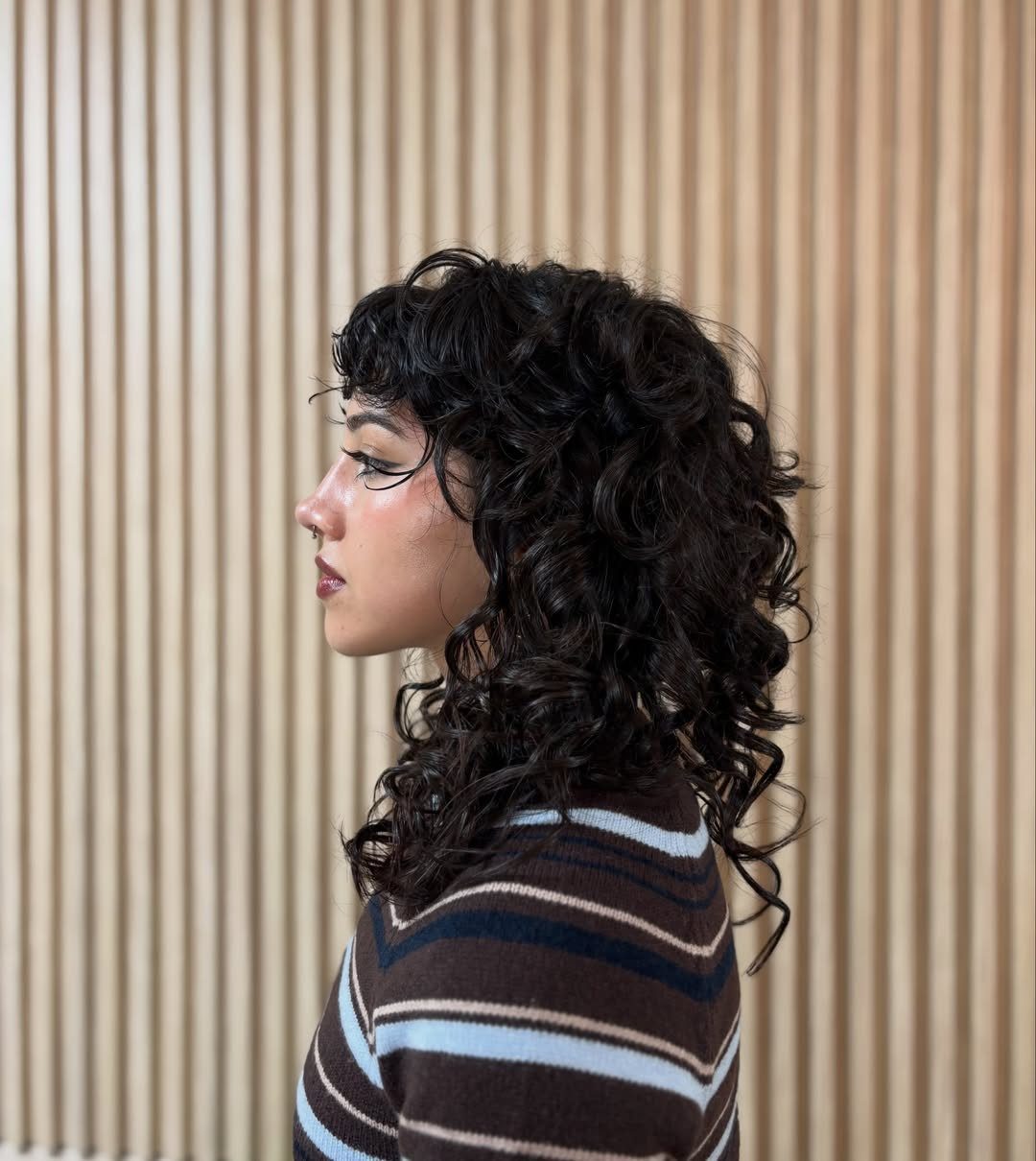
The ideas here run from a tight, close-cropped teeny weeny afro to long curls worn loose, and from a style that needs only a little cream to a braided bun that takes real time.
Daily styling time decides which one is yours, because the minutes you will realistically spend rule out some shapes faster than anything else.
Cropped cuts lose their outline fastest, so book the next appointment at 6–8 weeks for those and closer to 12 for longer lengths.
1. Curly Shag
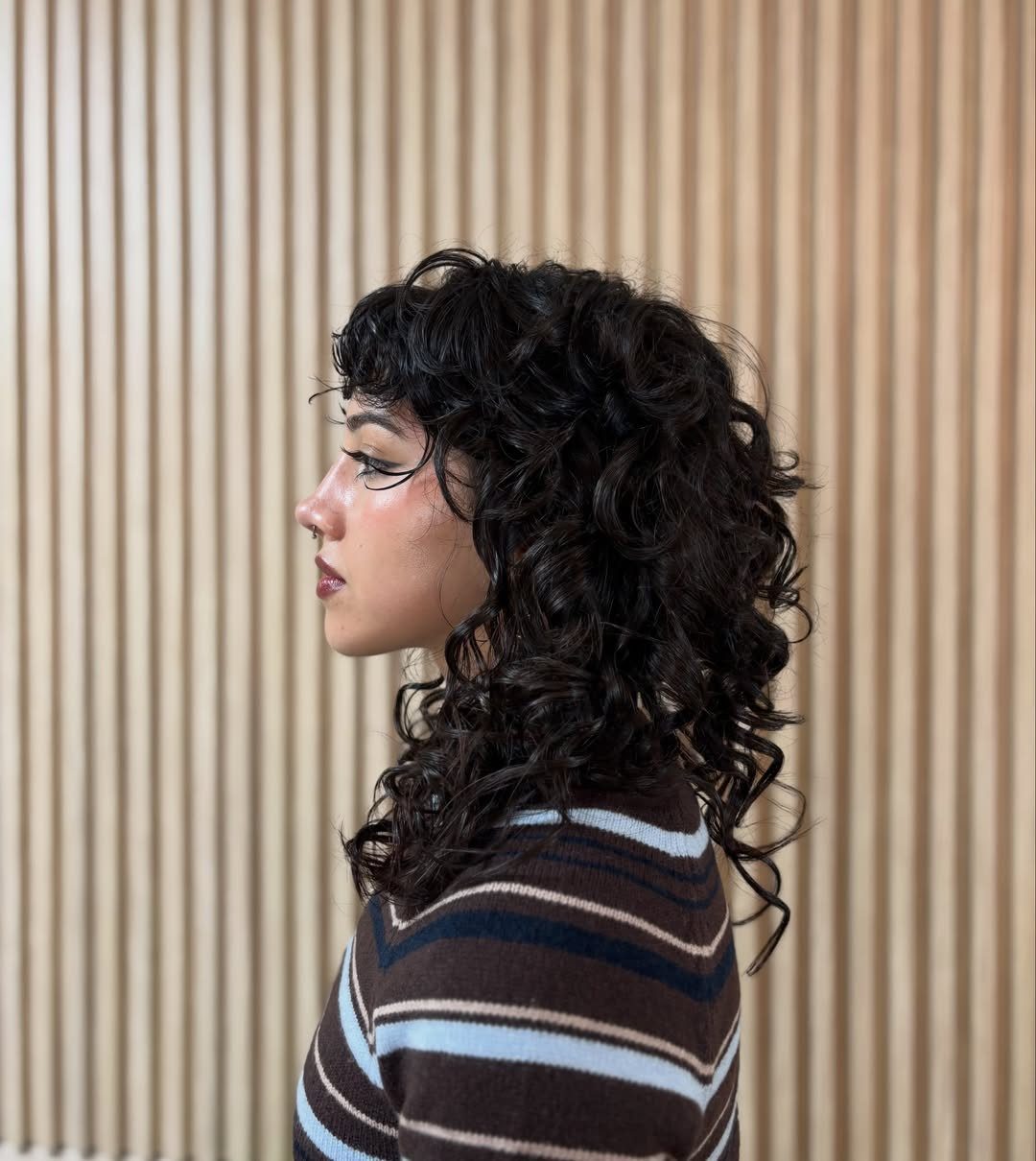
Layers do the work in a shag. Cut at different lengths, they keep curls from stacking into a heavy triangle and give the shape its deliberately undone look.
Bangs blended into those layers, as in this version, make it feel like one cut instead of two.
Ask for a stylist who cuts curly hair, because layers go wrong fast when the curl pattern is misread. Semi-curly hair can go either way: scrunch for definition, or leave it loose and fluffy.
2. Curly Pixie
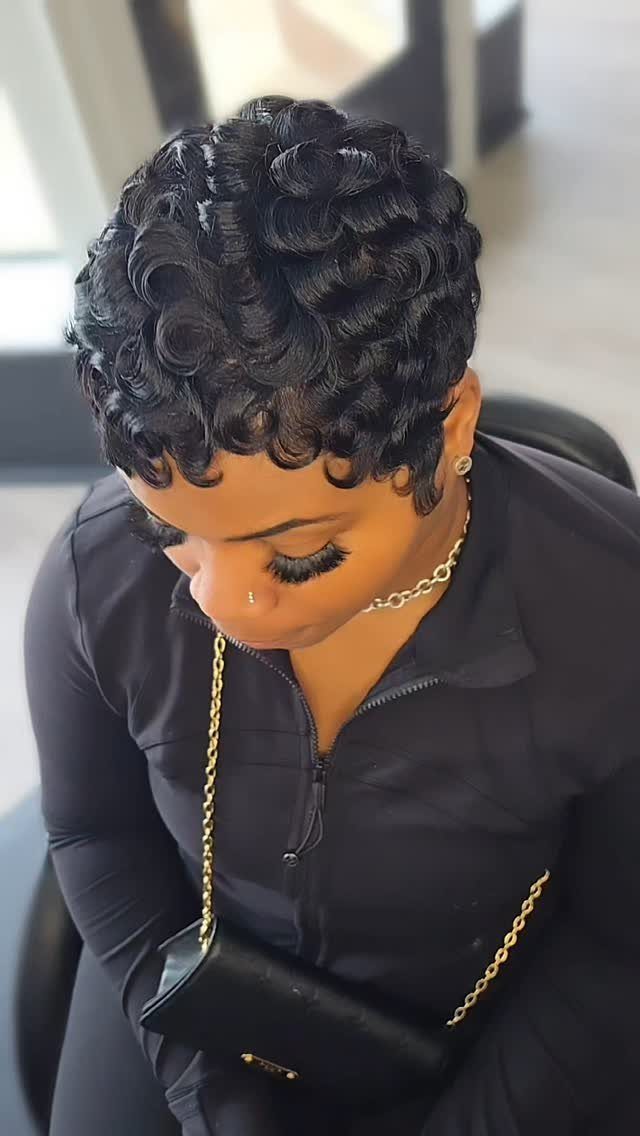
With so little hair to hide behind, a curly pixie puts the focus on cheekbones, jawline and eyes. Tight curls give the cut a rounded, sculpted outline without any styling effort.
Short cuts lose their shape quickly, so plan on a trim every month or two.
Earrings and chain necklaces carry more weight here, and I’d lean into them. If you’re unsure, ask the stylist to leave a little extra length on top.
3. Curly Bangs
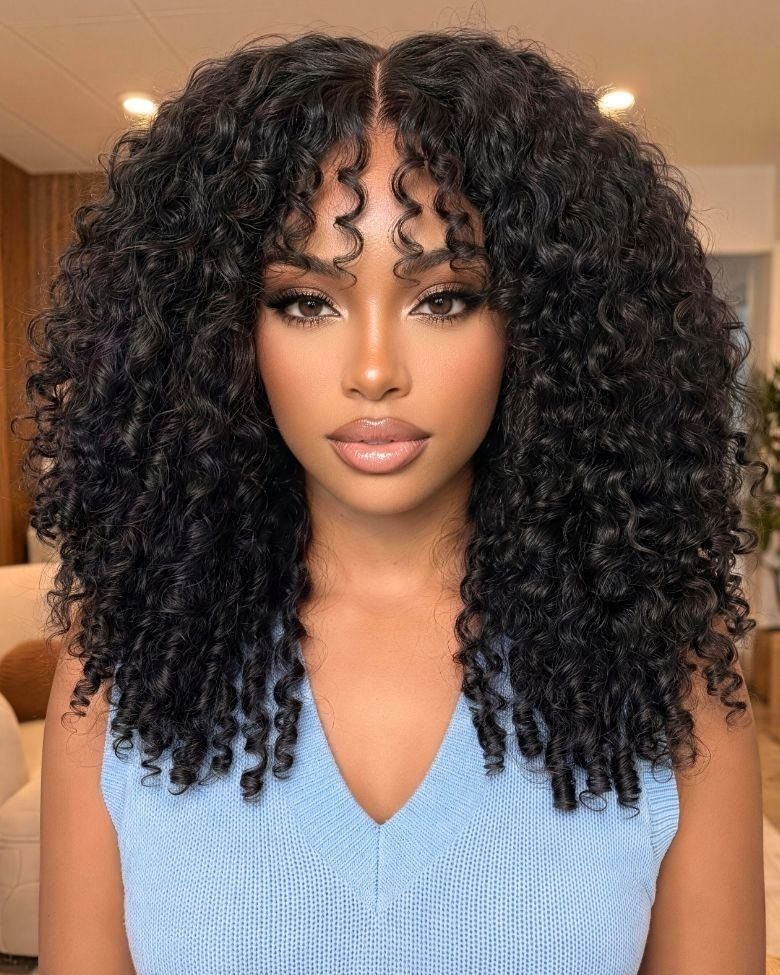
Curls spring up as they dry, so bangs end up shorter than they looked when wet. Ask your stylist to cut them dry, or leave them longer than you want them to land.
The range is wide: soft and wispy for a light frame, or short and graphic for a statement.
I’d start with the soft version, since it grows out gracefully. Curly bangs also need a bit of daily attention, so expect a quick refresh each morning.
4. Curly Pixie Bob
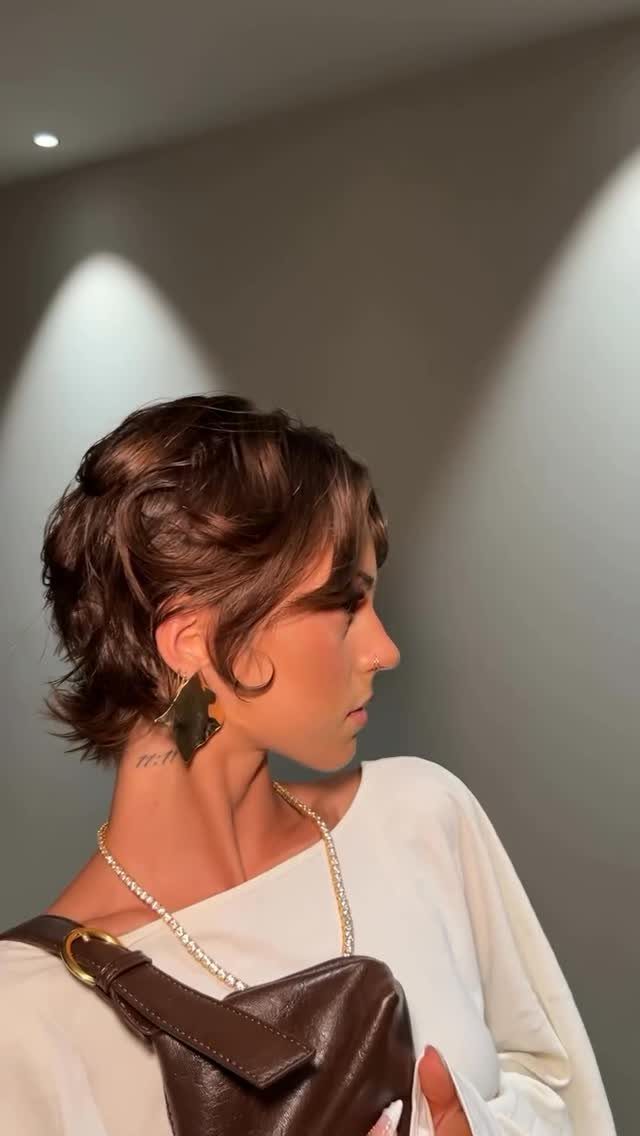
Pixie too short, bob too heavy? This cut sits between them, with enough length to show off waves and a crown that can stay choppy or tousled.
I prefer the tousled version for semi-curly hair, because the natural bends do the styling for you.
Choppy layers keep the shape from going flat. Ask a stylist who cuts textured hair to shape it, and expect regular trims to hold the outline.
5. Fluffy Ponytail
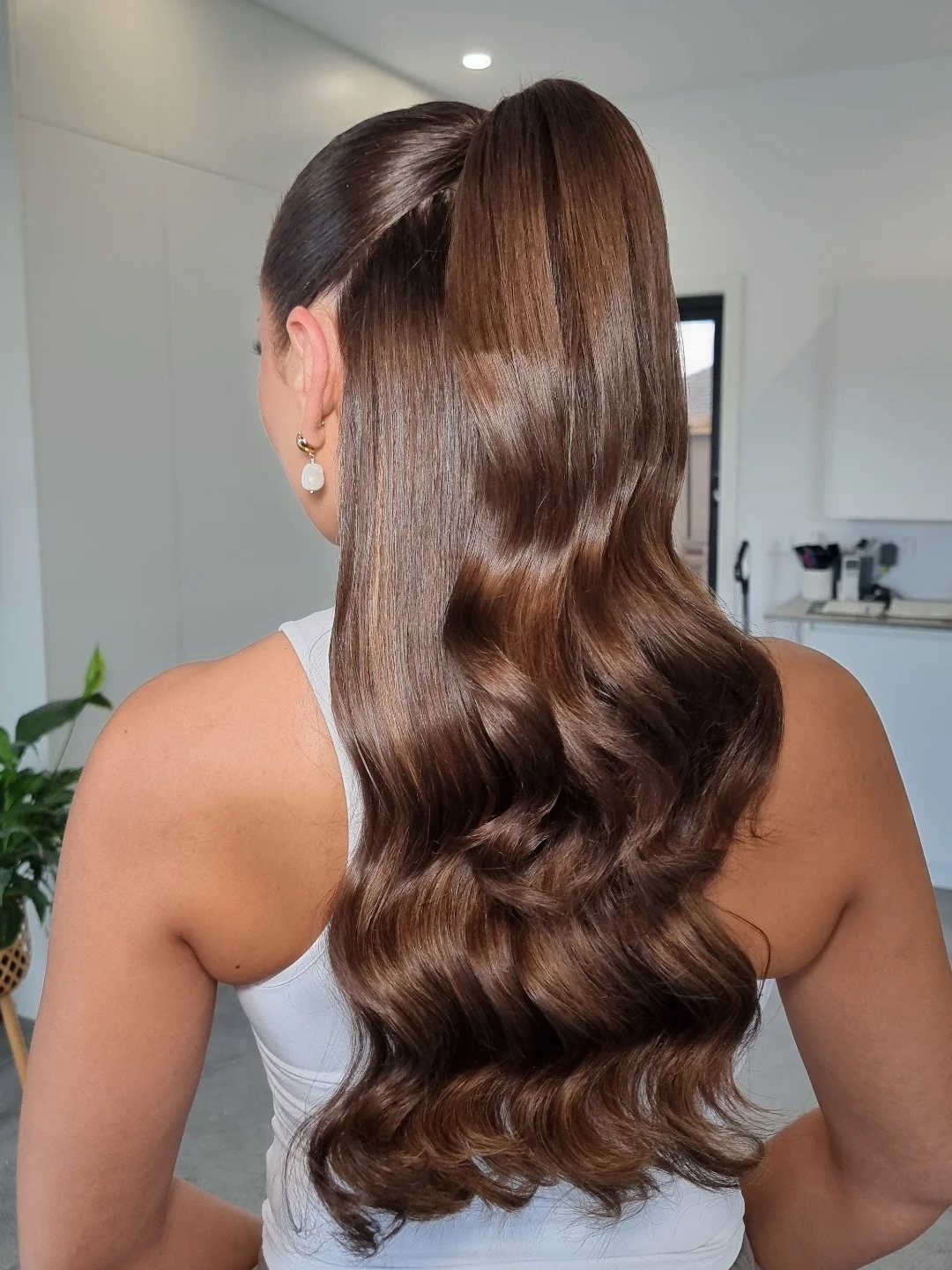
Slick the crown, leave the ends alone. A smooth, sleek top pulled high against curls that puff out freely from the tie gives this ponytail its shape.
Work a little gel or cream over the roots with a brush, then gather the hair at the highest point you can comfortably hold. Skip brushing the ponytail itself.
Fluff it with your fingers instead, and the curls keep their volume. It’s a good option for days when styling time is short.
6. Curly Mohawk
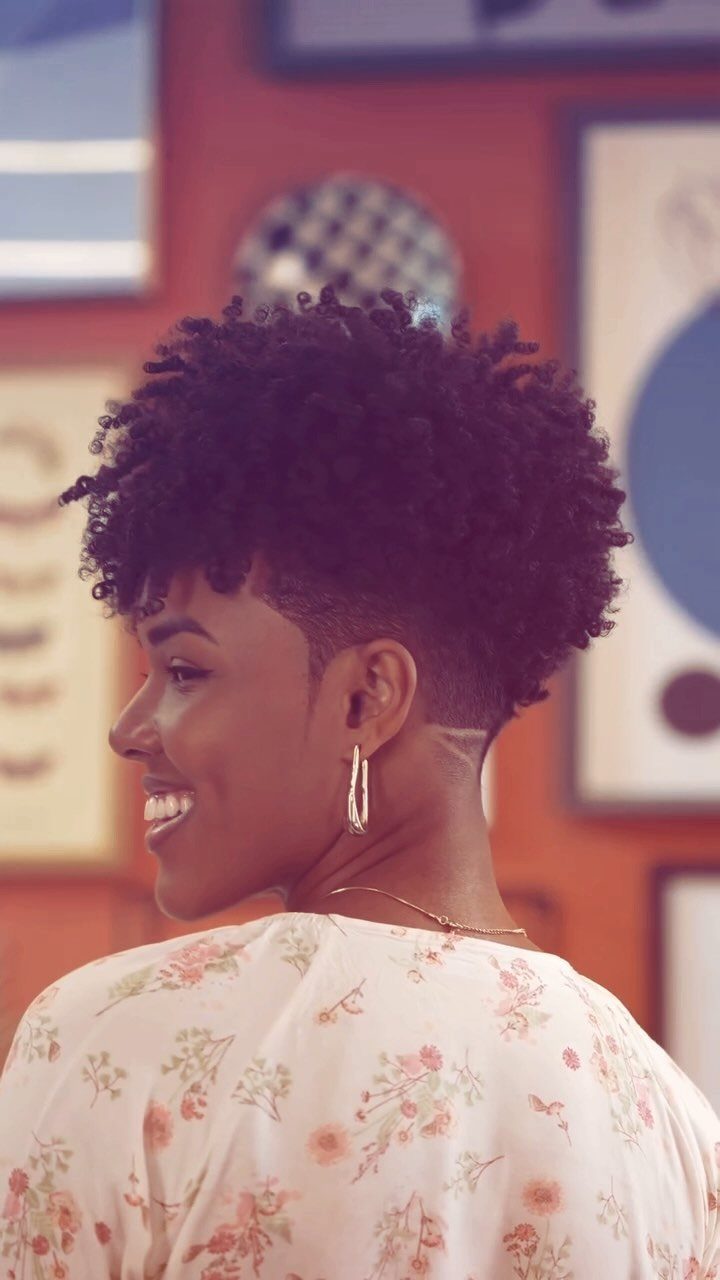
Nearly all the volume lives on top and runs down toward the nape, while the sides stay cropped close. That contrast is what makes a curly mohawk read as bold instead of just short.
Semi-curly hair has enough spring to hold the height.
Cropped sides grow out fast, so expect frequent clipper touch-ups. Find a barber or stylist comfortable with curls, and show them where you want the length to end at the back.
7. Voluminous Curly Afro
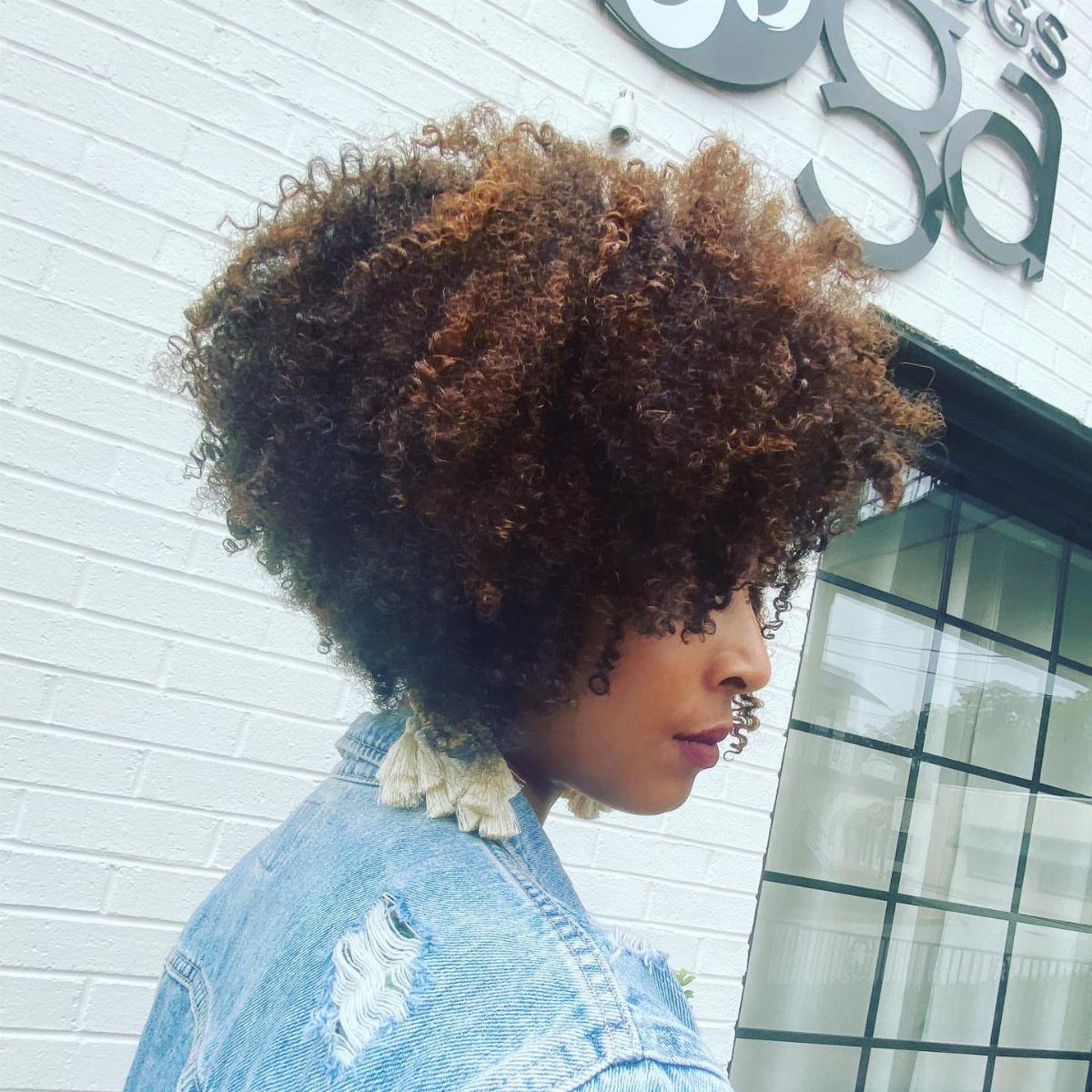
A brushed-out afro turns natural curls into one rounded, full shape, and the outline is where the care goes. Pick it out evenly all the way around so no side looks flatter than the others.
On semi-curly hair, I’d pick it out gently with fingers or a wide-tooth pick rather than a fine brush. Denim and statement earrings sit well against all that volume.
8. Asymmetrical Bob
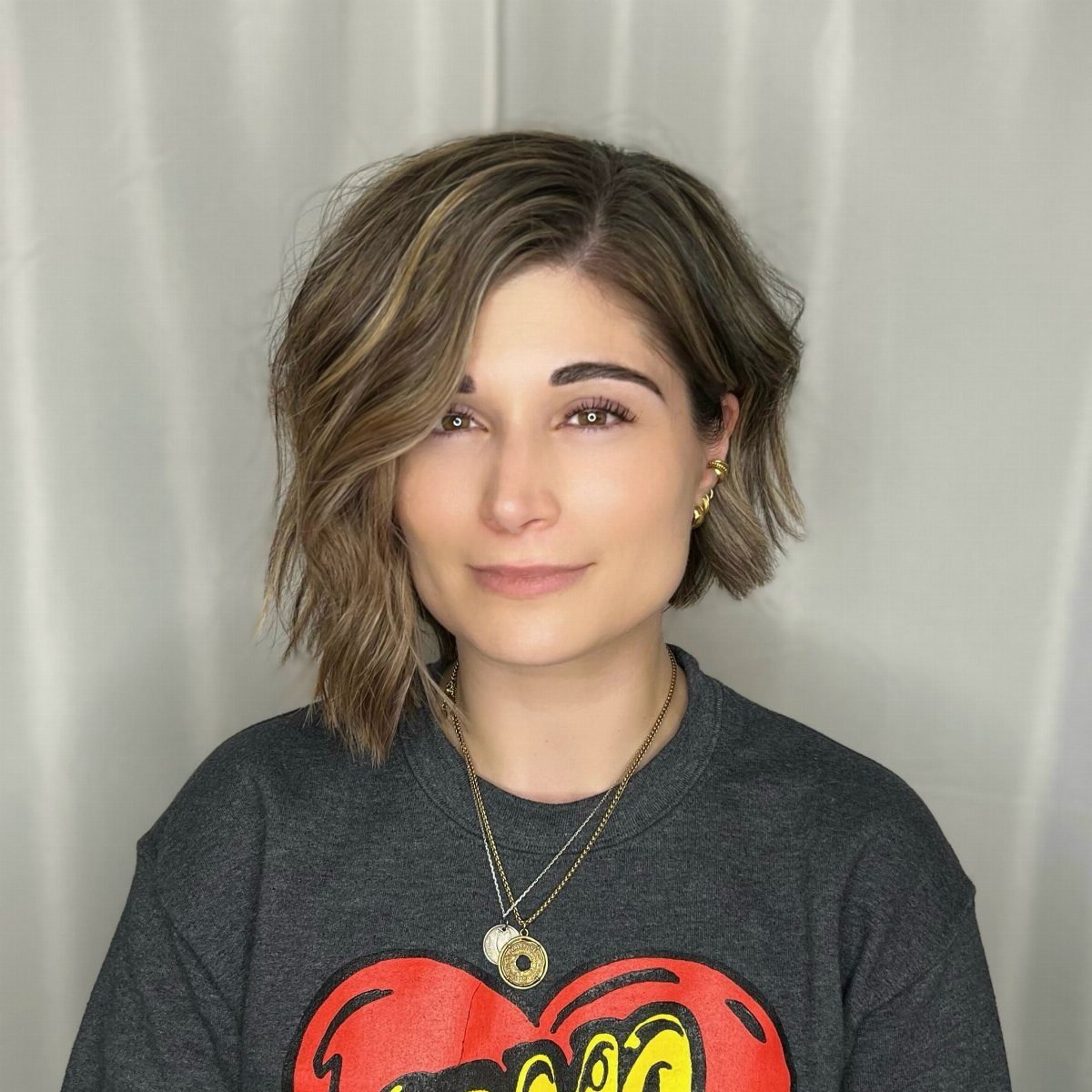
One side longer than the other gives this bob its angle, and that slant frames the face more sharply than an even cut would.
Loose waves soften the line, which suits semi-curly hair, since the natural bends add movement without much work.
Ask for the longer side to fall where you want the face framed, and bring a photo so the angle is clear.
Highlights help the cut read, because the different lengths catch the light. Expect regular trims to keep the slant crisp.
9. Wispy Bangs with Lob
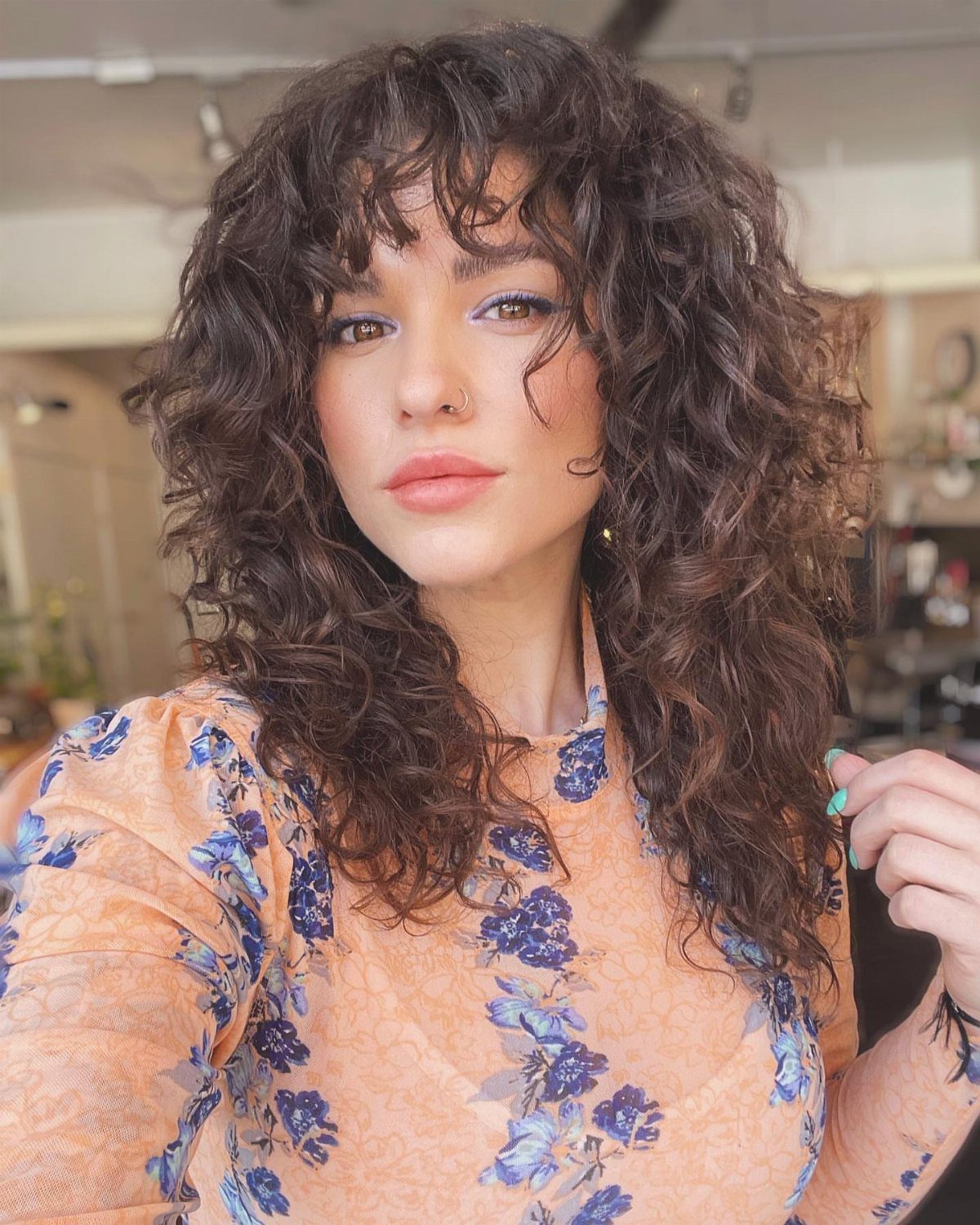
A curly lob with layers already has movement; wispy bangs give it a looser, lived-in top. Keep them thin and let the curls sit naturally instead of pulling them straight.
Curls shrink as they dry, so I’d ask for the bangs to be cut dry or left a little long.
Layers stop the lob from stacking into a heavy shape. Curly bangs and layers both depend on how the cutter reads your curl pattern, so book someone who works with texture daily.
10. Side-swept Curls
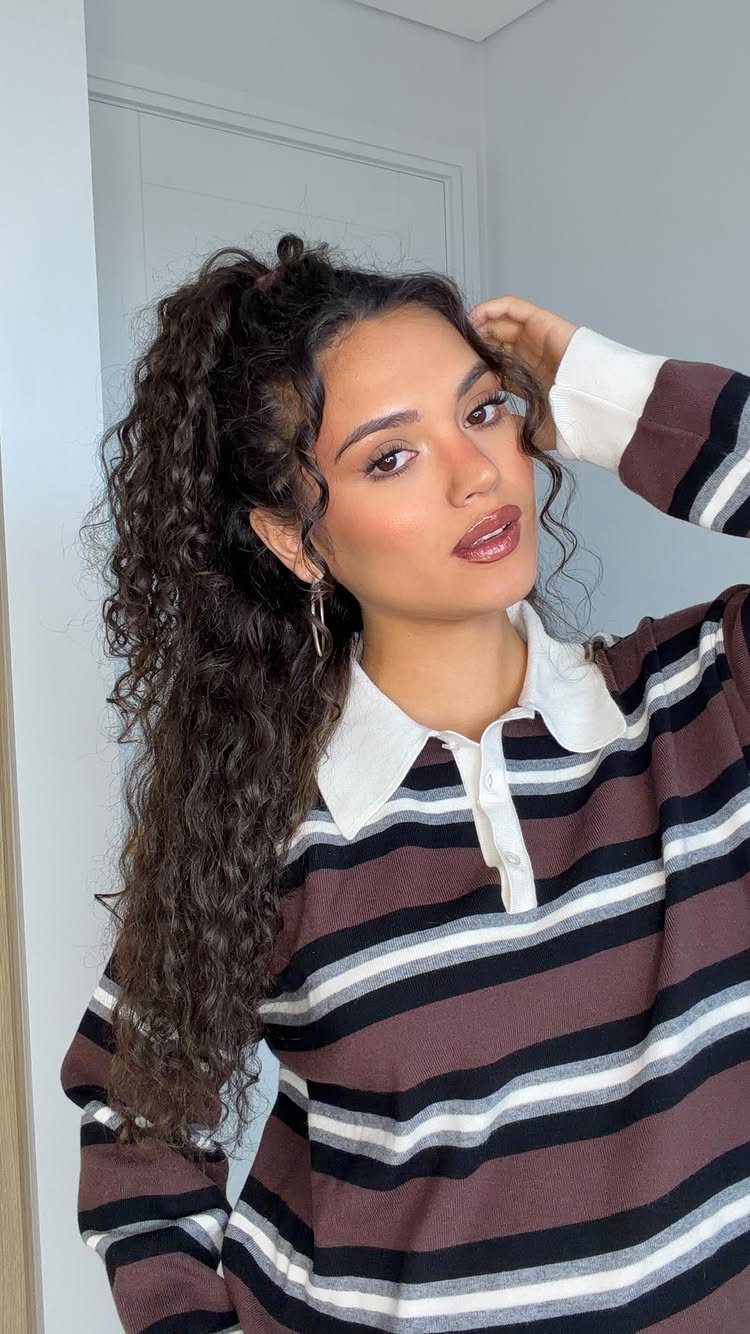
A slight side part is all it takes to send curls over one shoulder, and it adds shape to long hair that might otherwise fall straight down.
Part it with your fingers on dry or nearly dry hair, then let the curls settle where they land.
I like it on semi-curly hair because it needs no heat and almost no effort.
A light cream keeps the curls defined. Switch the part to the other side whenever you want a different look.
11. Beachy Loose Waves
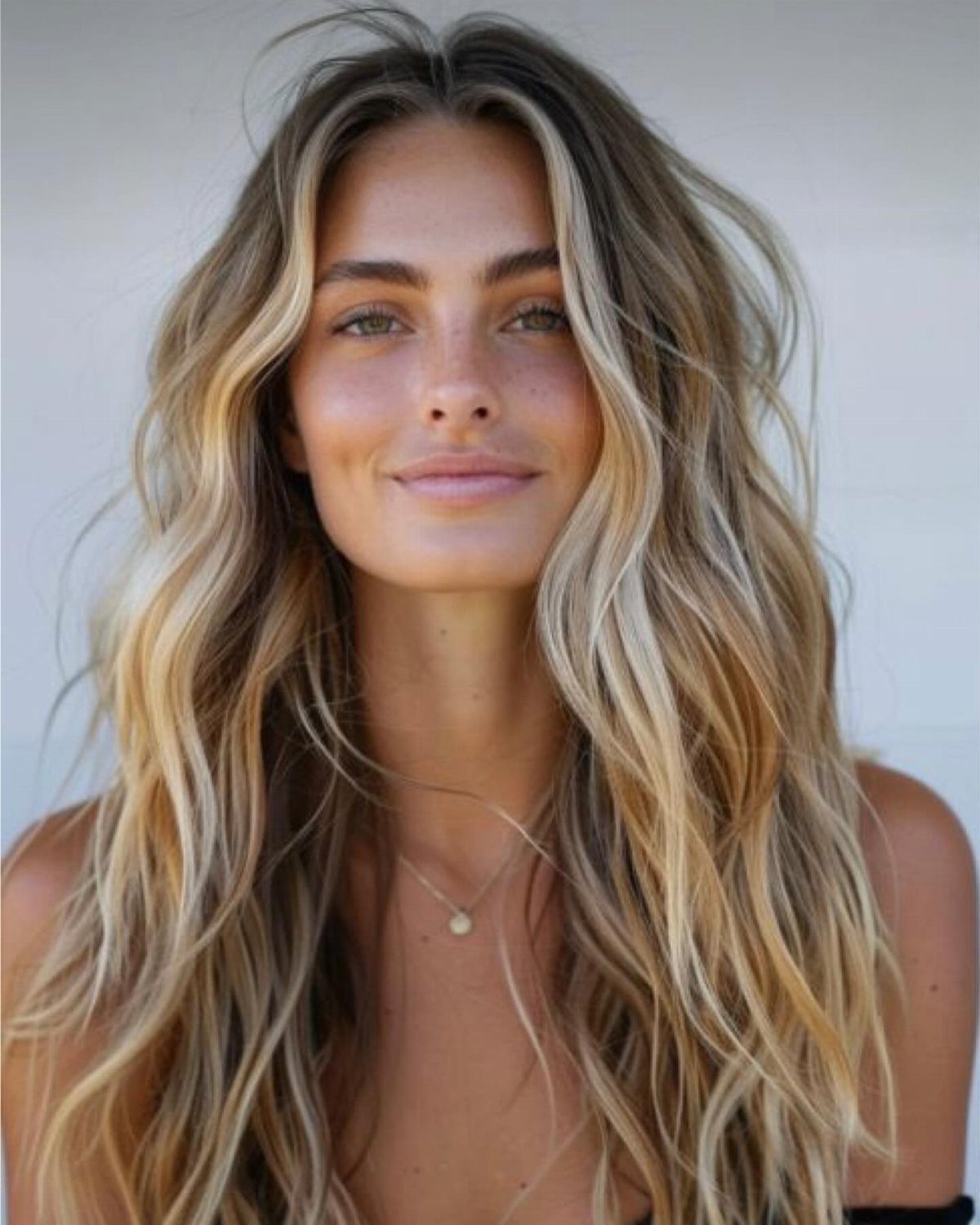
Loose, beachy waves read softer than tight curls, and semi-curly hair is a natural fit since it already bends that way. Scrunch in a light cream or spray while the hair is damp, then leave it alone to dry.
Skip the brush, because it turns waves into frizz.
Sun-kissed highlights add dimension, though they are a separate color service and not part of the styling. This is a good pick for low-effort days.
12. Curly Bob
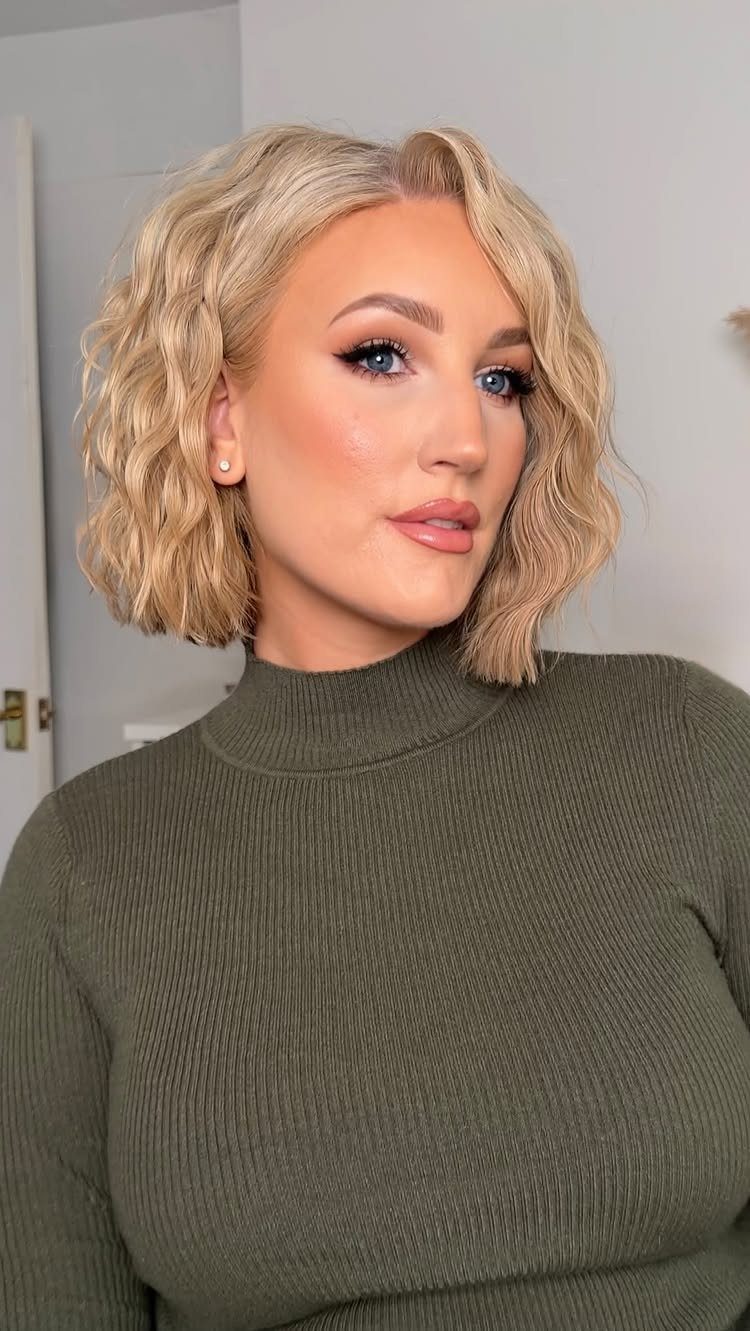
A bob cut around the curls puts the shape on display, and length and layering decide the finish. Shorter, more layered versions feel bouncy; longer, blunter ones sit heavier and smoother.
For semi-curly hair, I’d keep a few layers so the curls don’t stack into a triangle.
Ask a stylist who cuts curly hair, ideally on dry hair, because curls spring up as they dry and a bob can end up shorter than planned. Plan on regular trims to hold the outline.
13. Layered Cut
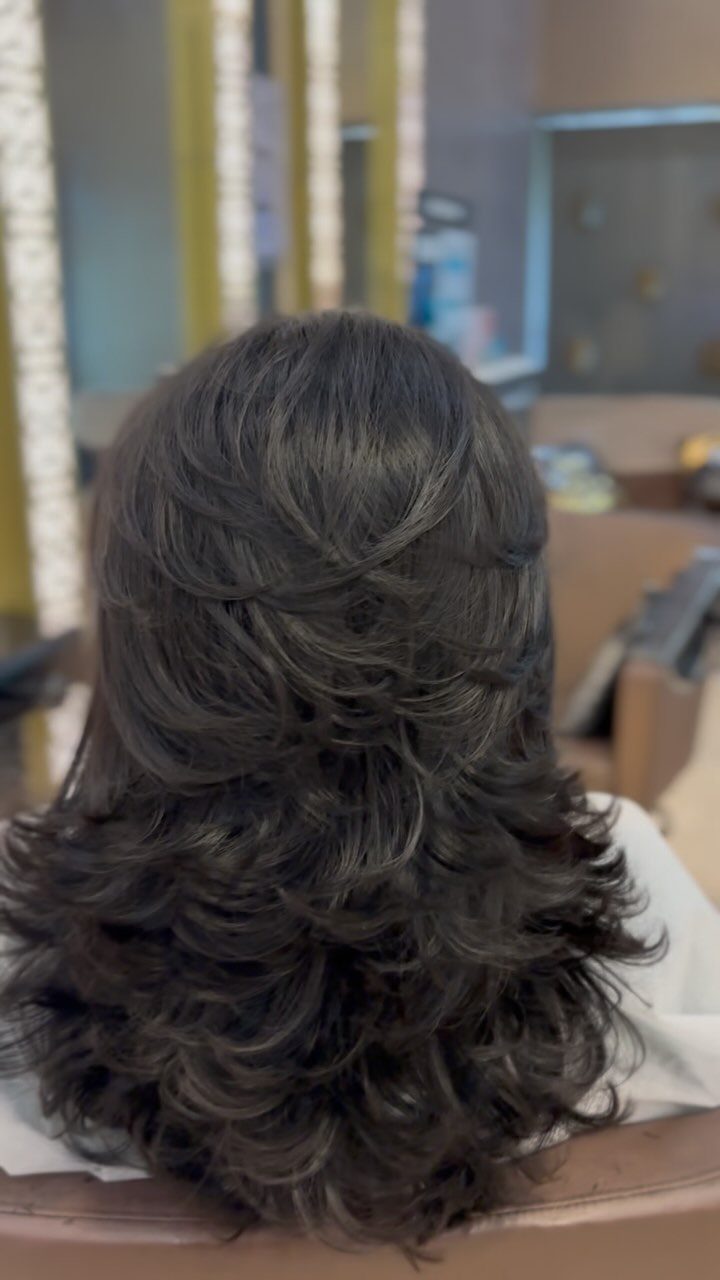
Layers break up the weight of medium or long curls and spread volume along the whole length instead of letting it collect at the bottom. The movement shows from behind, where each curl gets room to sit on its own.
On semi-curly hair, I’d ask for layers that blend softly rather than stepped, chunky ones. A stylist who cuts curly hair will read your pattern correctly, and that matters more here than in a one-length cut.
14. Natural Curls Down
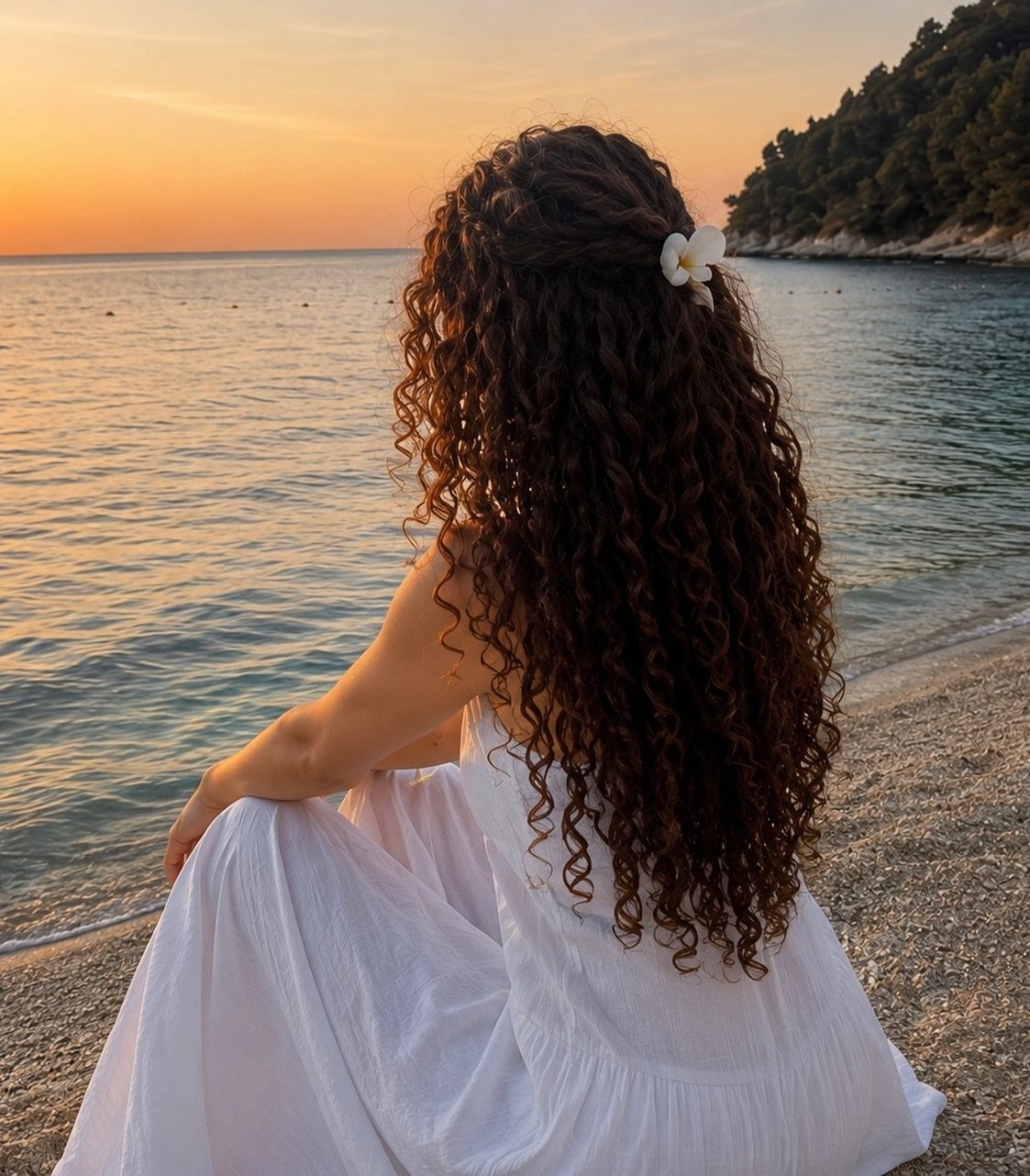
Nothing gets added or taken away here: the curls dry and fall in their own pattern, and that is the style. Long hair worn loose looks finished with one small accessory, like the white flower tucked in at the side.
For semi-curly hair, I’d work a light cream through damp strands and leave them alone as they dry.
Touching them while they dry breaks up the pattern. It’s an easy pick for days with no time to style.
15. Braided Bun
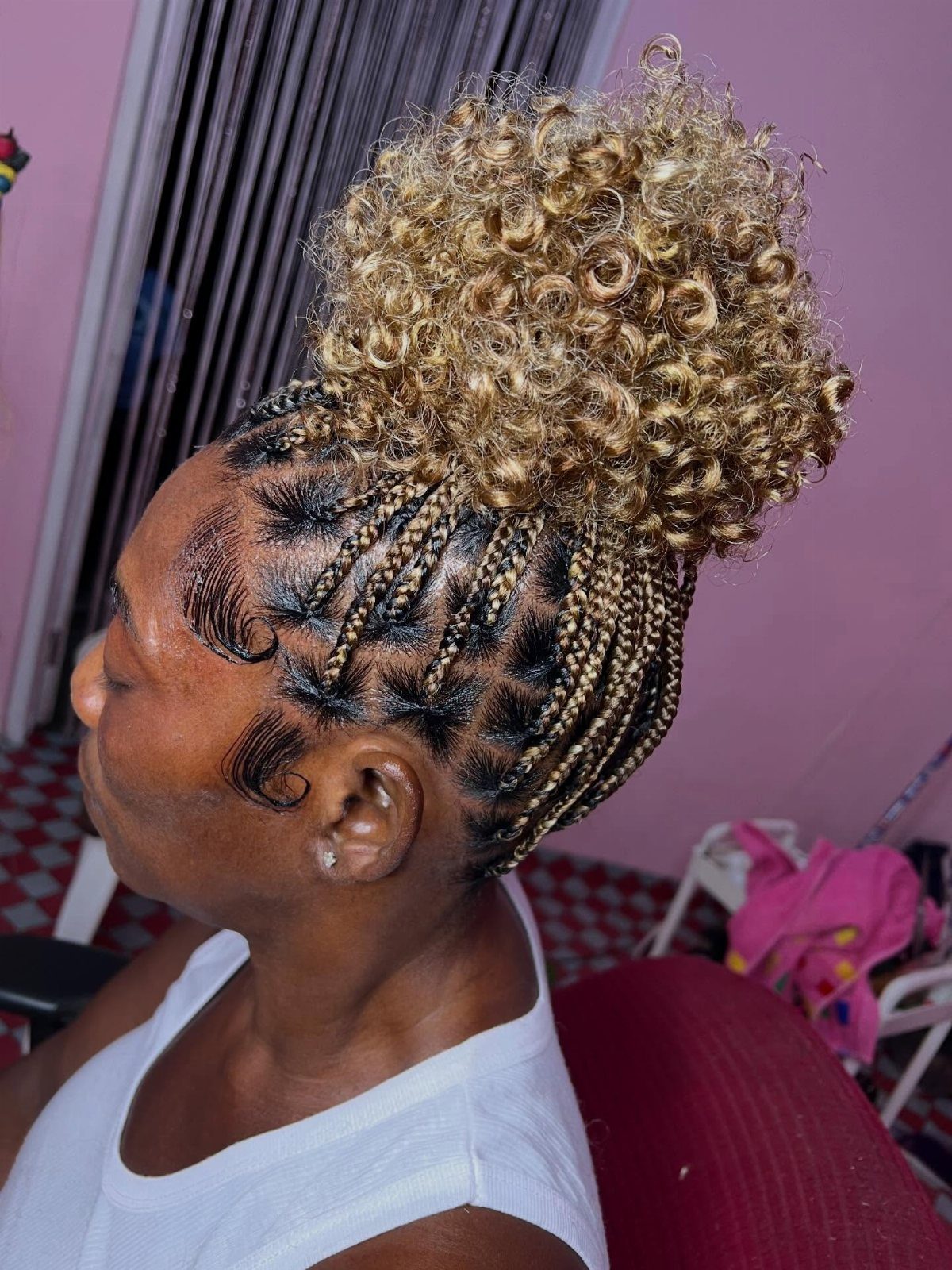
Braids that run back and end in a curly bun give the style 2 textures: flat and tight at the front, loose and full at the back.
Coil the braids around themselves at the nape or crown and pin the bun flat, so no strands work loose during the day.
I like that semi-curly hair adds natural body to the bun, so it looks full without much coaxing.
Braiding is the slow part, so a stylist or a patient friend helps. Pull out a few curls at the end for a softer finish.
16. Teeny Weenie Afro
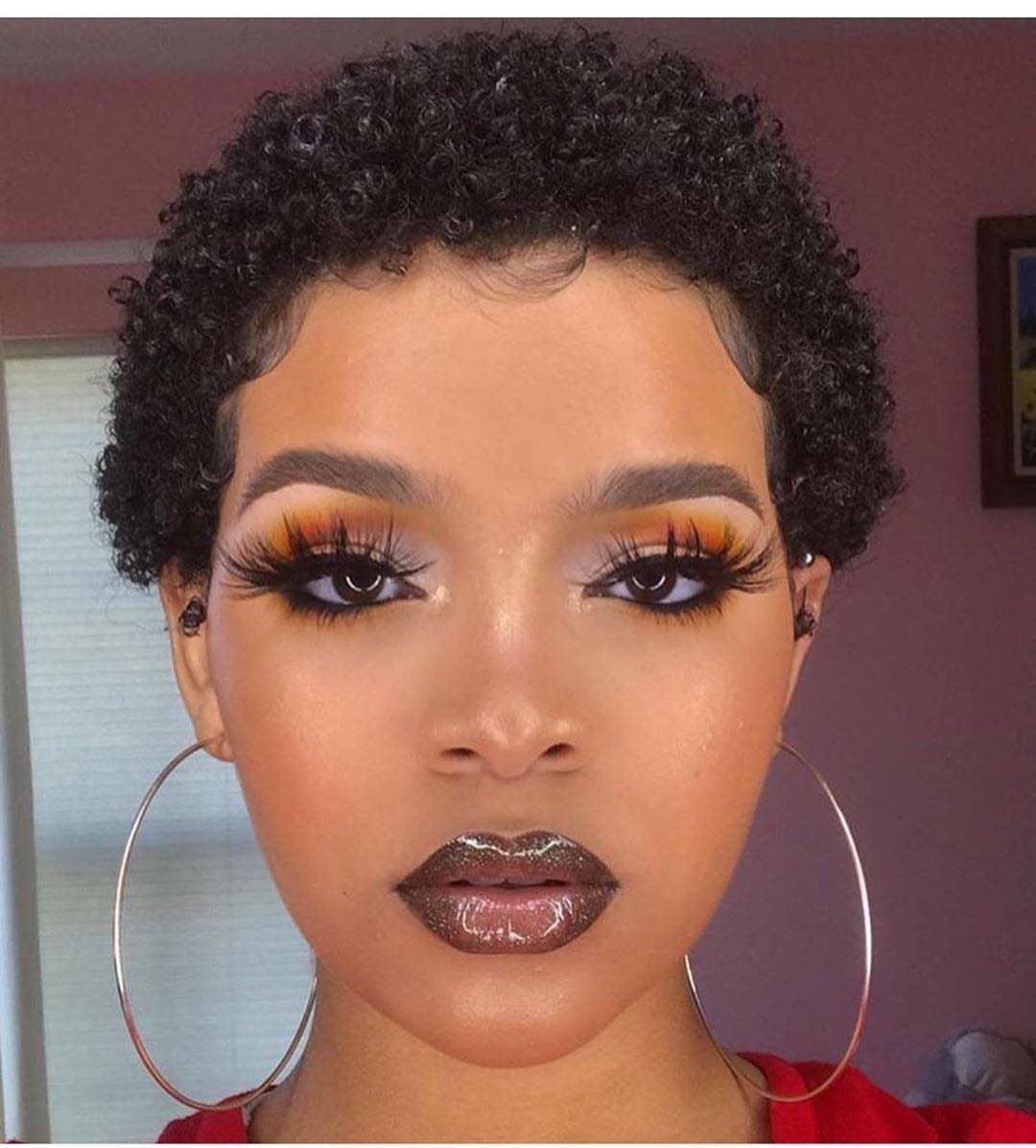
At this length the curls hug the scalp and read as a tight, round cap. Bold makeup and large hoops pair well with it, as the face does all the talking.
Because there’s so little length to hide behind, I’d start by asking the stylist to leave a bit more than you think you want, since curls spring up as they dry.
Short natural hair holds its shape best with regular trims, so plan on a visit every month or two.
17. Textured Pixie Cut
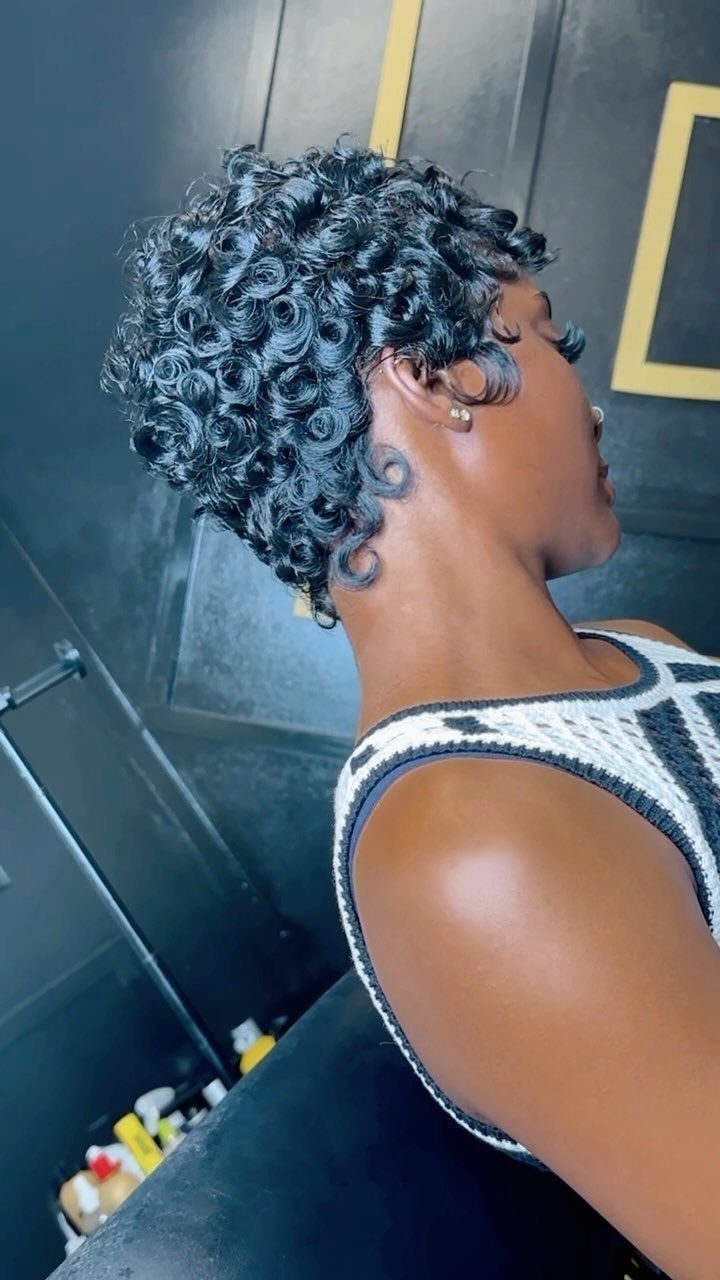
The soft, longer curls up top against closely tapered sides create a contrast that frames the face. Tight curls hold the texture without much help.
I’d ask for the top to be cut with the curl pattern in mind, since curls shrink as they dry.
A taper grows out quickly, so expect regular trims to keep the sides clean. Semi-curly hair works nicely here: a little cream is enough to define the top.
18. Curly Crop
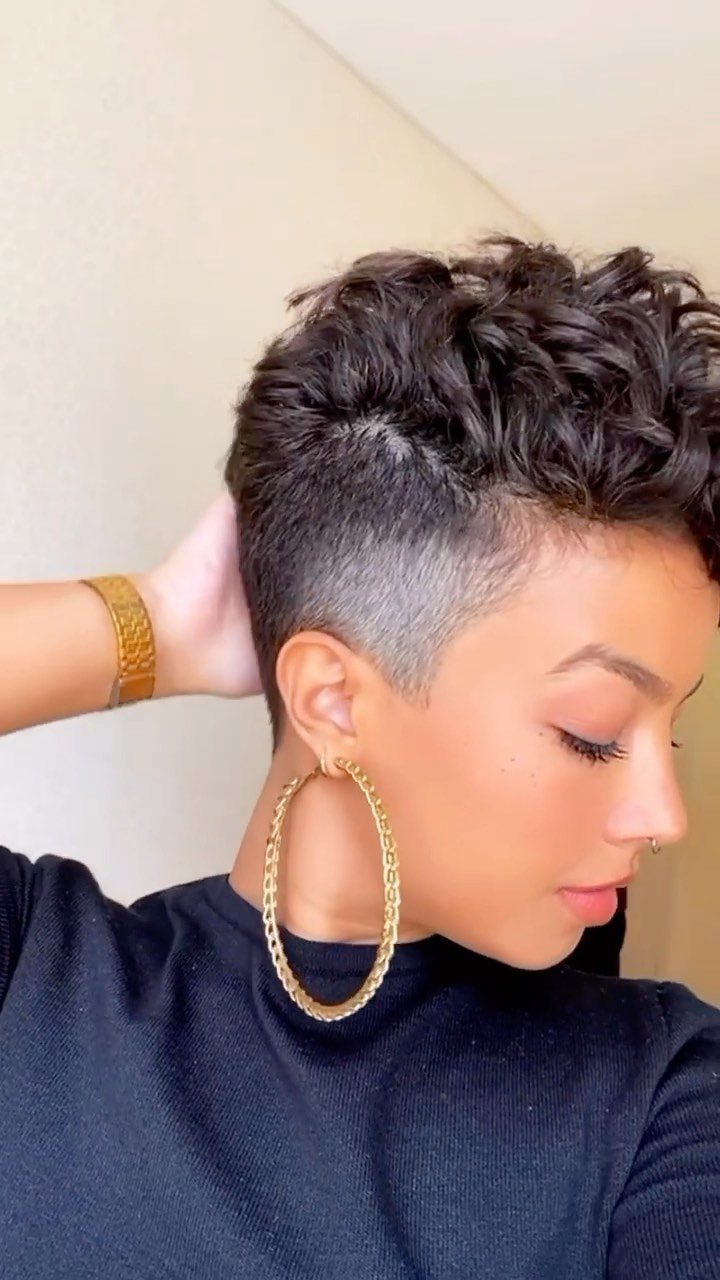
Short, close sides leave the curls on top to carry the entire shape. Curls give a crop its own volume, so it takes very little styling.
A fade loses its crispness within a few weeks, and a quick clipper cleanup around the ears and neckline brings it back.
Find a barber who is comfortable with curls, and ask them to leave enough length on top for the curls to show. I’d pair the cut with gold hoops, which stand out against the short sides.
19. Braided Crown Curls
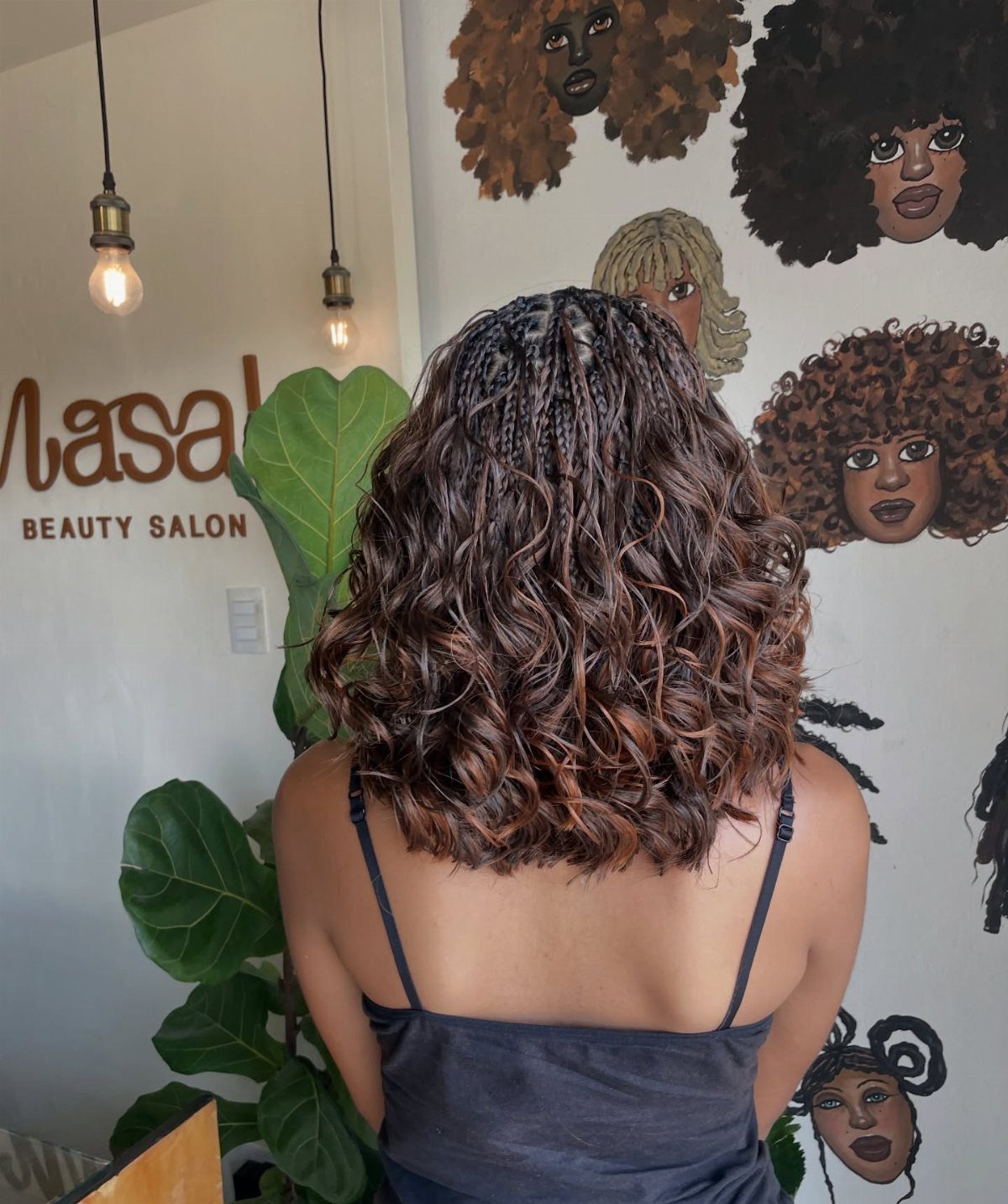
Small braids set along the crown give shoulder-length curls a detail that plain loose hair lacks, and the rest of the hair stays down and free.
Neat braids set against springy, loose curls give this style its pull, and neither half works as well alone.
On semi-curly hair, I’d keep the braids thin so the crown stays delicate and the curls below still get to be the main event.
Choosing and Communicating a Cut
Thick curls and fine curls call for different cutting methods.
On thick hair, a dry cut lets the stylist see how each curl sits and shape it one at a time, which guards against over-cutting. Fine curls often do better with a wet cut.
Before booking, weigh your curl pattern, face shape, hair texture and hair health. Add the amount of daily styling time you will realistically spend, because that rules out some shapes faster than anything else.
Show your stylist a few reference photos, and tell them plainly what your hair has been through and how you style it now.
Past color or treatments and the products you use on wash day all change what a stylist can do.
Treat the photos as a starting point. Ask how the shape would adapt to your pattern instead of expecting an exact copy.
Alternatively, if you have fine, curly and coily hair, a wet cut might be more suitable. Keep in mind that curly hair shrinks when dry, so consider leaving some extra length to account for this.
— ELLE
Moisture and Frizz Care
Frizz is mostly a hydration problem, so start there. On wet hair, work a wide-tooth comb from the ends up toward the roots, and skip brushing once the hair is dry.
A leave-in conditioner goes on first, ahead of any gel, mousse or cream. Styling on wet, coated hair gives you slip, and slip means less breakage.
One stylist’s method is to dampen each section with water first, then add a cream or foam as the moisturizer and a gel on top to seal.
Water-soluble products rinse out cleanly, and heavy butters and oils are better left on the shelf.
At night, a satin bonnet, a satin pillowcase or a loose scrunchie cuts down on friction and pulling. Keep heat tools to a minimum, since a curling iron may define some curls but costs you moisture.
Trims and Haircut Upkeep
Plan on a trim every 8–12 weeks. Curls split and snap more easily than straight hair, so trimming on a regular schedule clears out damaged ends and holds the shape of the cut.
Texture shifts the timing, and some curly cuts can stretch to about 12 weeks. A short crop needs more attention: about every 6 weeks.
Growing your hair out is no reason to skip appointments. You can space them further apart, but trim the ends regularly so damage does not travel up the hair shaft.
Frequently Asked Questions
How can I enhance my natural curls?
Frizz usually traces back to thirsty hair, so moisture comes first.
Work through wet hair with a wide-tooth comb, tips first and roots last, and smooth in a leave-in conditioner before any gel, mousse or cream; styling while the strands are still soaked gives the slip that stops snapping.
For frizz control, mist each section with water, work in a cream or foam for moisture, and finish with a gel to lock it in.
After that, keep your hands off while it dries, and sleep on a satin bonnet or pillowcase to cut friction.
Is my hair 2A or 2B or 2C?
These are the 3 wavy types, running from a slight bend to the start of ringlets.
2A has a slight wave and stays less coily, 2B has a medium wave, and 2C is wavy hair that begins forming ringlets, especially when it is wet and styled well.
Check your hair in that wet, styled state, since that is when 2C shows itself most.
What is the DevaCut?
A Deva cut is a haircut made for curly hair.
The stylist shapes each curl individually rather than working in sections. Seeing every curl in its natural shape is what helps a stylist avoid taking off too much.
What are some examples of short to mid-length hairstyles for women with semi-curly hair?
Bobs and lobs lead the way: a curly bob with a few layers so the weight doesn’t gather into a triangle, an asymmetrical bob with one side longer and loose waves softening the line, or a layered lob with thin, wispy bangs.
A curly shag also works, since layers cut at different lengths keep the shape light.
For a low-effort option, loose beachy waves need only a light cream scrunched into damp hair and then left alone to dry. Whichever you pick, book a stylist who cuts curls regularly.
How do I find the right curly hairstyle for me?
Start with your curl pattern, face shape, texture and hair condition, then be honest about how many minutes you will really give styling each morning, since that number rules out some shapes right away.
Tighter curls tend to look great in voluminous cuts, while looser curls suit beachy styles.
Fine or thin hair may do better short, and thick curls can be worn long. A stylist who specializes in curly and coily hair can help you decide.
How do I ask my hairdresser for a curly hairstyle?
Show your stylist a few photos and tell the truth about your hair history: any color or chemical treatments, plus what goes in your hair on wash day.
Tell the stylist the length and overall shape you’re after, along with your curl type and face shape. Photos are a starting point, so ask how the cut would sit on your curls rather than expecting a carbon copy.
Dense curls tend to do well with a dry cut and fine curls with a wet one, and in both cases ask for a bit of extra length, because curls bounce up as they dry.
How often should you get your curly hair cut?
A trim every 8–12 weeks is a good schedule.
Curls break and split more readily than straight strands, and regular trims remove the damaged ends while keeping the cut’s shape. Some curly cuts stretch to about 12 weeks, while a short crop needs a visit about every 6 weeks.
While growing out your hair, stretch the gaps between appointments but still take a little off the ends so splits don’t climb the strand.
What should I look for in a curl specialist?
A stylist who sees textured hair all day and cuts it dry, with the curls in their natural pattern, is the one to book. Seeing how each curl sits makes over-cutting less likely.
Layered cuts depend on that skill most, since they go wrong quickly when the curl pattern gets misread. A barber who is at ease with curls works just as well for a short crop or fade.